
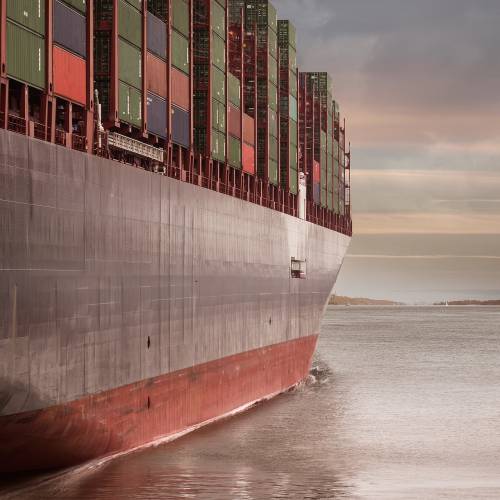
A total of 422 ships were forced to remain at a standstill for six days following the grounding of the Ever Given, which was refloated on Monday.
All vessels that had been waiting since the grounding of the Ever Given—an enormous container ship that became lodged across the Suez Canal on March 23—have now cleared the waterway, the Suez Canal Authority (SCA) announced on Saturday, April 3.
The 61 vessels that were still delayed transited the canal on Saturday, along with “24 new vessels,” the SCA said in a statement. In total, 422 ships carrying 26 million tonnes of cargo were forced to halt operations for six days.
Flying the Panamanian flag and operated by the Taiwanese shipping company Evergreen Marine Corporation, the Ever Given was successfully refloated on March 29. The vessel—roughly the length of four football fields—was then towed to the Great Bitter Lake in the middle section of the Suez Canal.
Nearly 200 members of the canal’s technical teams, assisted notably by SMIT Salvage, a Dutch company specializing in maritime rescue operations, managed to free the massive ship. The operation involved dredging 30,000 cubic meters of sand and deploying around a dozen tugboats.
Unprecedented in scale, the incident brought traffic to a complete halt along one of the world’s most important and heavily used shipping routes. Linking Asia and Europe, the canal accounts for more than 10% of global trade. According to the SCA, nearly 19,000 vessels transited the canal in 2020, an average of 51.5 ships per day.
Investigation Underway
The SCA has launched an investigation into the causes of the grounding. Its findings are expected to be made public in the coming days, according to SCA Chairman Osama Rabie, who spoke on Egyptian television channel MBC Masr on Friday evening.
Initially, strong winds and a sandstorm were blamed for the accident. However, Rabie later suggested that “human or technical errors” may also have played a role.
For the admiral, restoring traffic in what he described as “record time” represents “a new achievement” for Egypt. Stressing the canal’s importance “to the world,” Egyptian President Abdel Fattah el-Sisi pledged on Tuesday that Egypt would acquire additional specialized equipment to better respond to similar incidents in the future.
According to the SCA, Egypt lost between $12 million and $15 million for each day the canal remained closed. Estimates of the total value of cargo delayed or rerouted—including oil, livestock, and other goods—varied widely, ranging from $3 billion to more than $9 billion.
As one of Egypt’s main sources of revenue, the canal generated approximately $5.7 billion for Cairo during the 2019–2020 fiscal year.
A major expansion project was carried out on part of the canal between 2014 and 2015. However, President el-Sisi dismissed the idea of widening the southern section of the canal, where the incident occurred.
“Economically, it is not useful,” he said, while mentioning that Egypt was considering “other projects to link the Red Sea and the Mediterranean.”